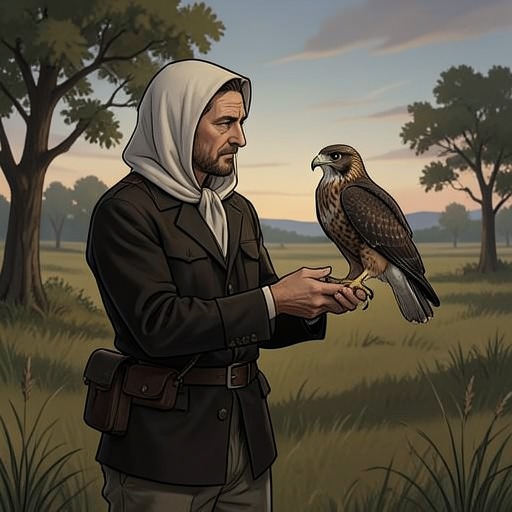
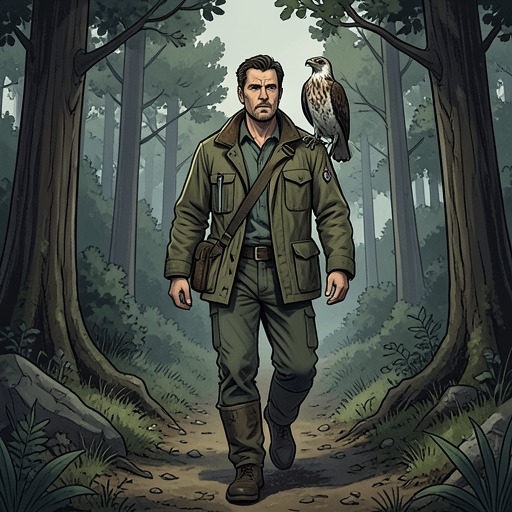
T. H. White resigns from Stowe and retreats to the countryside
H is for HawkT. H. White’s resignation from Stowe School was not simply a change of employment but a deliberate retreat from the social life and self-discipline he had come to distrust. In the countryside he imagined a different existence, and a story about a goshawk returning to the wild gave that withdrawal a defining emblem. The departure joined practical escape to a larger hope: that training a hawk might also let White remake himself.
Dissatisfaction at Stowe
On 16 March 1936, White, Head of English at Stowe School, sat in the former stables with a notebook on his knees, wondering whether the book he was writing might save him. School life seemed unreal to him. He had grown intolerant of his colleagues and of the boys, whom he privately found repellent in a crowd. He had concluded that he needed to leave, although the future he imagined was not yet settled.
His notebook, a grey volume marked with a photograph of one of his grass snakes, was principally a dream diary, but it also held lesson plans, drawings, scraps of writing, and notes of self-analysis. Among these were recurring questions about the need to excel in order to be loved, and about what it meant to fail at that demand. The record makes his professional crisis part of a more intimate reckoning: the wish to leave Stowe was bound up with his sense that the standards by which he had tried to earn acceptance had not brought him happiness.
At first he pictured a cottage in Scotland and days spent fishing for salmon. He also entertained the possibility of taking with him a barmaid he had been courting, but that hoped-for future remained uncertain. He was drinking too much and had been unhappy for a long time. The resignation therefore began not as a confident plan for a new life but as a wish to get out of one that had become intolerable.
The decision to withdraw
White’s disaffection extended beyond the school. He had come to distrust pursuits he had once valued, including foxhunting and flying, because he associated them with death, social privilege, and the pressure to excel. His growing preference for animals over people accompanied a wish for isolation; he described the solution as lying in being alone. During the spring vacation he went fishing by himself in Belmullet, on the west coast of Ireland. The experience strengthened his resolve, and he resigned from Stowe School while there.
The decision required courage, he acknowledged to a friend, because he did not know what would follow and felt that analysis had taken him only partway toward understanding himself. His plan to build a future around the barmaid had also fallen away. Resignation thus meant relinquishing both an established professional position and one imagined route into a different life, without replacing either with security.
A hawk as a new direction
The rural retreat acquired a more definite purpose when White read Gilbert Blaine’s account of a lost goshawk. Blaine described a bird that had been domesticated on the day it disappeared and had returned to a feral state within a week. White seized on the possibility of such a transformation. He took a farm labourer’s cottage for five shillings a week and wrote to Germany for a goshawk.
The bird came to signify more than a new subject for his writing. White connected the hawk’s imagined ferocity and freedom with qualities he had suppressed in himself, including his sexuality and his desire for mastery. He intended to train the bird, learn from the attempt, and write a book about the demanding art. The project offered a counter-image to the schoolroom and its expectations: not a settled solution to his uncertainty, but a difficult undertaking through which he hoped to test another way of living.
Social context and significance
White’s turn toward a goshawk also shifted him away from the status attached to traditional falconry. The peregrine was celebrated as a noble bird, but flying falcons properly required extensive open land, access more readily available to the wealthy or well connected. By contrast, a goshawk could hunt over a much wider range of places. The solitary trainer of goshawks had often been disparaged in falconry writing, and the bird itself was frequently represented as difficult and disreputable. In choosing the goshawk, White turned toward a practice and animal positioned outside the prestige of aristocratic falconry.
His retreat should not be mistaken for a simple escape into pastoral calm. War was drawing nearer, and White feared that political ambition and modern civilization would bring catastrophe. He imagined that, in the disorder to come, a person living in the countryside might survive by flying a goshawk and eating the pheasants it caught. That vision gave his withdrawal an apocalyptic edge: the cottage and the hawk promised a life beyond the institutions he rejected, but they were also part of a private preparation for a world he expected to break apart. The resignation therefore opened onto both a practical change of place and a hazardous experiment in identity, with the hawk standing at the center of White’s hope for a feral freedom he could not yet claim for himself.